Have you ever watched someone walk into a room and just win — before they even said a word? Maybe it was the way they spoke. Maybe it was how calm they stayed while everyone else panicked.
Whatever it was, they had an edge. And chances are, you’ve tried to describe that edge to someone else and struggled to find the right words. That’s where similes come in.
I use similes all the time when I write, and honestly, they feel like a magic trick. In simple terms, a simile compares two different things using “like” or “as.” That’s it.
For example, if I say “her confidence was like a shield in battle,” you instantly see what I mean. You don’t just read it — you feel it.
So why should you care about similes? Because plain writing is forgettable. When you write about having an advantage, a simile helps your reader taste that edge. It shows speed, power, or quiet skill in a way that sticks.
In this post, I’m going to walk you through the meaning of similes, share 30 examples of similes for advantage, and show you exactly how to use similes in writing.
Part 1: The Pull — Similes for the Grip of Addiction
These similes describe how addiction grabs hold.
1. Addiction is like a riptide.
Meaning: It looks calm on the surface but pulls you out fast.
Explanation: A riptide does not splash or shout. It drags. This simile shows how addiction can take hold before anyone notices, including you.
Example Sentences:
- At first, his drinking was like a riptide — quiet, then suddenly too strong to swim against.
- She did not see it coming. It was like a riptide under a calm sea.
2. Addiction is like a vine that grows while you sleep.
Meaning: It spreads slowly, and you do not notice until it is wrapped around everything.
Explanation: This simile captures the slow creep of habit. It is not dramatic. It is patient.
Example Sentences:
- His habit was like a vine that grew while he slept — one small choice at a time.
- By the time she looked up, it was like a vine that had covered the whole house.
3. Addiction is like a song stuck in your head.
Meaning: It repeats, even when you want it to stop.
Explanation: This shows the mental loop. You are not always choosing it. It plays on its own.
Example Sentences:
- The craving was like a song stuck in his head — same three notes, all day.
- She tried to focus on work, but it was like a song stuck in her head.
4. Addiction is like gravity.
Meaning: It pulls you down without asking.
Explanation: This simile shows how natural the pull feels. It is not a fight you chose. It is a force you feel.
Example Sentences:
- Every evening, the urge was like gravity — quiet and constant.
- He stood near the bar and felt it, like gravity.
5. Addiction is like a wolf in sheep’s clothing.
Meaning: It looks harmless, even friendly, but it is not.
Explanation: This is one of the clearest examples of similes for how addiction hides its cost. The first taste feels like comfort.
Example Sentences:
- The pills seemed safe at first, like a wolf in sheep’s clothing.
- His new “friends” were like a wolf in sheep’s clothing.
6. Addiction is like a knot that tightens when you pull.
Meaning: The harder you fight alone, the tighter it gets.
Explanation: This shows why willpower alone often fails. The knot needs another pair of hands.
Example Sentences:
- Every time he tried to quit alone, it was like a knot that tightened when he pulled.
- Her shame was like a knot that tightened when she pulled.
Part 2: The Mind — Similes for Cravings and Denial
These similes describe what addiction does inside your head.
7. A craving is like an itch you cannot reach.
Meaning: It nags at you until it is all you can think about.
Explanation: This simile shows how small the feeling starts and how big it becomes. It is not pain. It is worse. It is almost relief.
Example Sentences:
- The urge was like an itch he could not reach, no matter how he sat.
- She kept busy all day, but it was like an itch she could not reach.
8. Denial is like a fogged-up window.
Meaning: You can see shapes, but not clearly.
Explanation: This shows how addiction blurs self-awareness. You are not lying. You truly cannot see.
Example Sentences:
- He looked at his life like a fogged-up window.
- Her excuses were like a fogged-up window — real to her, unclear to everyone else.
9. Addiction is like a bad lawyer in your head.
Meaning: It always has a reason, and the reason always wins.
Explanation: This simile shows the bargaining. “Just once.” “You earned it.” “No one has to know.”
Example Sentences:
- Every night, the excuse was like a bad lawyer in his head.
- She argued with herself, but it was like a bad lawyer in her head.
10. Shame is like a coat you cannot take off.
Meaning: You carry it everywhere, even when you are warm.
Explanation: This is one of the more honest creative writing similes for the emotional weight of addiction. Shame does not leave when the drinking stops.
Example Sentences:
- Even after a year sober, it was like a coat he could not take off.
- She walked into the meeting like a coat she could not take off.
11. Addiction is like a cracked mirror.
Meaning: You still see yourself, but the picture is warped.
Explanation: This shows broken self-image. The person is still there. The reflection is not.
Example Sentences:
- He looked in the mirror and saw himself like a cracked mirror.
- Her sense of who she was became like a cracked mirror.
12. Addiction is like a voice that sounds like your own.
Meaning: The urge speaks in your voice, so you trust it.
Explanation: This is a sharper version of the “voice in your ear” idea. The danger is not that it is loud. It is that it sounds like you.
Example Sentences:
- The thought came like a voice that sounded like his own.
- She could not tell which ideas were hers and which were like a voice that sounded like her own.
Part 3: The Cost — Similes for What Addiction Takes
These similes show the damage, without drama.
13. Addiction is like a leaky boat.
Meaning: You keep rowing, but you are always taking on water.
Explanation: This shows the daily effort of hiding and managing. You are always bailing, never sailing.
Example Sentences:
- His life was like a leaky boat — always moving, never arriving.
- She kept the family together like a leaky boat.
14. Addiction is like a debt with hidden interest.
Meaning: The cost grows even when you are not using.
Explanation: This simile shows the delayed bill — health, trust, money, time.
Example Sentences:
- The years of drinking were like a debt with hidden interest.
- His lies stacked up like a debt with hidden interest.
15. Addiction is like a fire that starts small.
Meaning: It begins as a spark and ends as a blaze.
Explanation: This is one of the clearest examples of similes for how addiction grows. The early stages never look like the late stages.
Example Sentences:
- His habit was like a fire that started small and took the whole house.
- It began like a fire that starts small — one drink, one night.
16. Addiction is like a hollow tree.
Meaning: It looks solid from the outside, but it is empty inside.
Explanation: This shows how public life can look fine while private life crumbles.
Example Sentences:
- His career stood tall, like a hollow tree.
- The family photo looked happy, like a hollow tree.
17. Addiction is like a hand on your shoulder that never lets go.
Meaning: It follows you into every room.
Explanation: This shows the persistence of the past. Recovery is not forgetting. It is learning to walk with it.
Example Sentences:
- Even at his daughter’s wedding, it was like a hand on his shoulder.
- She felt it in every quiet moment, like a hand on her shoulder.
18. Addiction is like a thief who moves in slowly.
Meaning: It takes things one at a time until you notice the room is empty.
Explanation: This shows how addiction steals trust, sleep, joy, and time — never all at once.
Example Sentences:
- It was like a thief who moved in slowly, taking one friend at a time.
- His weekends disappeared like a thief who moved in slowly.
Part 4: The Fight — Similes for Recovery and Relapse
These similes describe the long, uneven work of getting better.
19. Recovery is like learning to walk on a broken leg.
Meaning: It is slow, painful, and needs help.
Explanation: This simile pushes back on the “just stop” myth. Healing takes time and support.
Example Sentences:
- His first month sober was like learning to walk on a broken leg.
- She rebuilt her life like learning to walk on a broken leg.
20. Relapse is like a pothole on a road you have driven a hundred times.
Meaning: You know the way, but you can still hit it.
Explanation: This is one of the more honest creative writing similes for relapse. It is not the end of the road. It is a bump.
Example Sentences:
- His relapse was like a pothole on a road he knew well.
- She did not give up; it was like a pothole, not a wall.
21. Recovery is like a garden.
Meaning: It needs daily care, and it dies without it.
Explanation: This shows the ongoing nature of healing. You do not finish. You tend.
Example Sentences:
- His sobriety was like a garden — small work, every day.
- Her new routines were like a garden she watered each morning.
22. Asking for help is like opening a window in a smoky room.
Meaning: It does not fix everything, but suddenly you can breathe.
Explanation: This shows the first relief. The problem is still there. The air is different.
Example Sentences:
- His first meeting was like opening a window in a smoky room.
- Telling the truth was like opening a window in a smoky room.
23. Recovery is like a sunrise after a long night.
Meaning: The dark does not vanish all at once. It slowly gives way.
Explanation: This shows hope without pretending the night was short. It is a slow brightening, not a switch.
Example Sentences:
- His first sober week was like a sunrise after a long night.
- Her new life came like a sunrise after a long night.
24. Accountability is like a mirror someone else holds up.
Meaning: You see yourself through another person’s eyes.
Explanation: This shows why community matters. You cannot always see your own face.
Example Sentences:
- His sponsor was like a mirror someone else held up.
- Group therapy was like a mirror someone else held up.
Part 5: The Person — Similes for the Human Behind the Habit
These similes remind us that addiction is not the whole story.
25. A person with addiction is like an iceberg.
Meaning: You only see a small part above the surface.
Explanation: This shows how much is hidden — trauma, pain, fear, history. The habit is the tip.
Example Sentences:
- He was like an iceberg — calm on top, heavy underneath.
- She was like an iceberg, and the drinking was only the visible edge.
26. A person in recovery is like a bridge being rebuilt.
Meaning: The old one is gone, and the new one is still under construction.
Explanation: This shows the in-between season. Not who they were. Not yet who they are becoming.
Example Sentences:
- He was like a bridge being rebuilt — usable, but not finished.
- She was like a bridge being rebuilt, plank by plank.
27. A family facing addiction is like a house in a storm.
Meaning: Everyone is holding a different wall.
Explanation: This shows the shared strain. Each person carries a different piece of the weight.
Example Sentences:
- The family was like a house in a storm.
- Their home was like a house in a storm — quiet, tense, and holding on.
28. A parent in recovery is like a lighthouse.
Meaning: They do not control the sea, but they shine for others.
Explanation: This shows the quiet leadership of healing. Your story helps someone else find shore.
Example Sentences:
- She became like a lighthouse for her kids.
- His honesty was like a lighthouse for the next person walking in.
Part 6: The Hope — Similes for What Comes Next
These similes close the loop. They are not “happy endings.” They are honest openings.
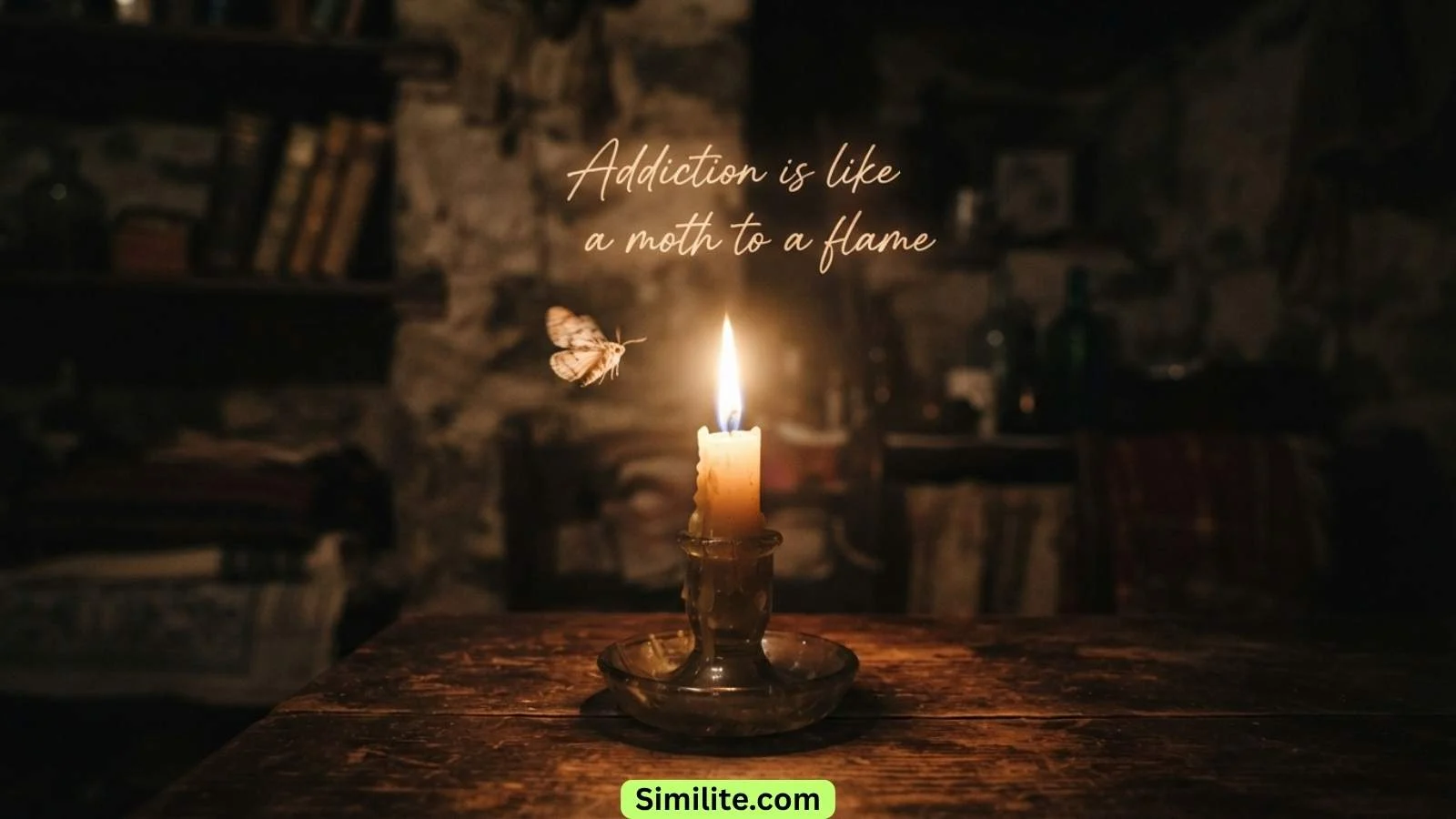
29. Hope is like a small flame in a windy place.
Meaning: It is fragile, but it is real.
Explanation: This shows the early days of change. The flame is small. It still gives light.
Example Sentences:
- His hope was like a small flame in a windy place.
- She kept going on hope like a small flame in a windy place.
30. Healing is like a scar.
Meaning: The wound closes, but the mark stays.
Explanation: This is the most honest simile in the list. Healing does not erase. It marks. The scar is proof of survival, not failure.
Example Sentences:
- His recovery was like a scar — not hidden, not shameful.
- She spoke of her past like a scar: healed, but still part of her.
Practical Exercise
Let’s test what you learned. Read each item and answer in your own words.
A: Identify the Simile
- “Her worry was like a storm in her mind.” Is this a simile? Why or why not?
- “The urge was a magnet.” Is this a simile or a metaphor? Explain.
- “He was as quiet as a mouse.” What two things are being compared?
B: Complete the Simile
- Recovery is like learning to walk on a ______.
- Shame is like a coat you cannot ______.
- Addiction is like a vine that grows while you ______.
C: Match the Meaning
Match each simile (7–10) with its meaning (A–D).
- Like a riptide
- Like a cracked mirror
- Like a pothole
- Like a scar
Meanings:
A. A setback, not the end
B. A warped view of yourself
C. Proof of healing that stays
D. A calm surface with a strong pull
D: Write Your Own
- Write one simile for the word “craving.” Use “like” or “as.”
- Write one simile for the word “hope.”
Correct Answers and Explanations
- Yes. It uses “like” to compare worry to a storm.
- Metaphor. It does not use “like” or “as.” Change it to “like a magnet” to make it a simile.
- The person and a mouse. Both share the trait of being quiet.
- broken leg. This shows that recovery is slow and needs help.
- take off. This shows that shame stays close, even after the habit stops.
- sleep. This shows how addiction grows quietly over time.
- D. A riptide is calm on top and strong underneath.
- B. A cracked mirror shows a broken self-image.
- A. A pothole is a setback, not the end of the road.
- C. A scar is healed tissue with a lasting mark.
- Sample answer: “The craving was like a song I could not turn off.”
- Sample answer: “Hope was like a small flame in a windy place.”
FAQs
1. What is the meaning of similes?
The meaning of similes is simple: a simile compares two unlike things using “like” or “as” to make an idea clearer. For example, “quiet as a mouse.” It does not say the two things are the same. It says they are similar in one way.
2. What are some examples of similes?
Common examples of similes include “brave as a lion,” “fast as a cheetah,” and “strong like a rock.” In writing about addiction, you might say, “The urge was like a riptide.”
3. How do I use similes in writing?
To learn how to use similes in writing, follow three steps. First, name the feeling. Second, ask what else feels that way. Third, connect them with “like” or “as.” Keep the comparison short. If the reader has to work to understand it, simplify it.
4. Why are creative writing similes useful for hard topics?
Creative writing similes turn invisible feelings into visible images. That helps readers connect to your story. It also helps the writer. Sometimes it is easier to say “it was like a chain” than to explain the whole chain.
5. Can similes help when talking about addiction?
Yes. Addiction is hard to describe, and similes give people a way in. Phrases like “like a riptide” or “like a pothole” can reduce shame because they describe the experience, not the person. But similes are expressive tools, not treatment. If you or someone you know needs help, contact a doctor or a local helpline.
6. What makes a good simile sentence?
A good simile sentence is short and clear. For example, “Her hope was like a small flame.” It compares hope to a flame and shows it is weak but alive. Avoid stacking too many similes in one paragraph. One strong simile beats three weak ones.
7. How is a simile different from a metaphor?
A simile uses “like” or “as.” A metaphor does not. “He is a rock” is a metaphor. “He is steady as a rock” is a simile. Both are useful. Just label them correctly in your writing.
8. Can I make my own similes for addiction?
Yes. Start with what you feel, not what you see. Ask, “What else feels like this?” Then write it with “like” or “as.” Test it on one reader. If they nod, you have a simile that works.
Conclusion
Similes are small tools with real power. They turn hard feelings into clear pictures. They help you say what plain words cannot.
In this article, we looked at the meaning of similes, walked through 30 examples of similes for addiction, and practiced how to use similes in writing when the topic is heavy. The best creative writing similes do not decorate. They reveal.
Keep one thing in mind. A simile can explain addiction. It cannot treat it. If this topic is close to your life, please reach out to a doctor, a counselor, or a local helpline. Then keep writing. One simile a day. Your words will do the rest.