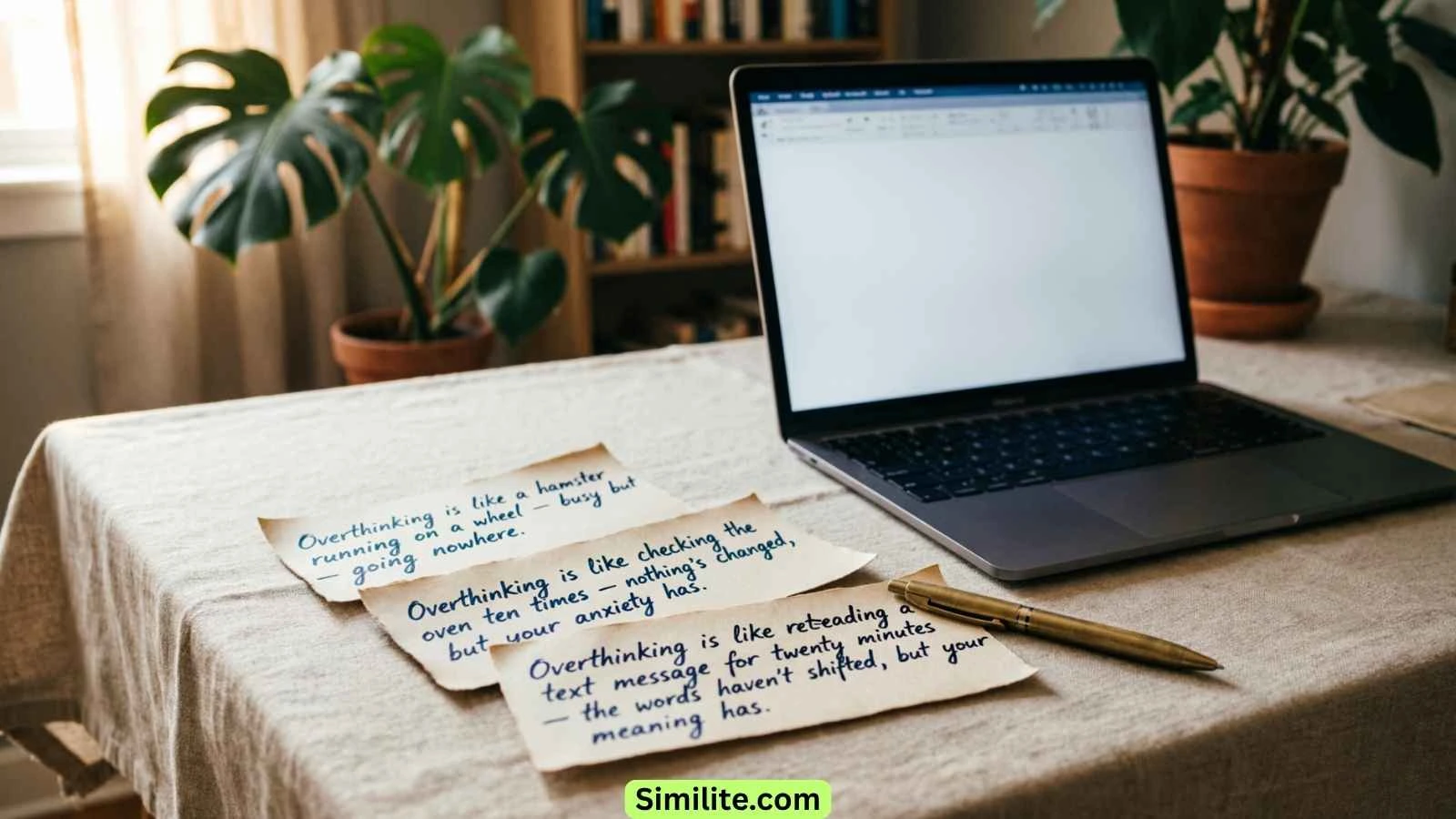
Have you ever had thoughts that just wouldn’t stop? Maybe you lay in bed at night, and your brain keeps running like a hamster on a wheel. That’s overthinking. And similes can help us describe this feeling perfectly.
What are similes? In simple terms, a simile is a figure of speech that compares two different things using the words “like” or “as.” For example, “busy as a bee” or “runs like the wind.” Similes make our writing more colorful and help readers understand exactly what we mean.
When we talk about overthinking, similes become incredibly useful. They help us explain that racing mind feeling to others. They also make our creative writing more powerful and relatable.
Let’s explore 30 amazing similes for overthinking that you can use in your daily life and writing.
30 Similes for Overthinking
1. Overthinking is like a hamster on a wheel
Meaning: This simile means your thoughts keep going in circles without making progress.
Explanation: When a hamster runs on a wheel, it moves a lot but stays in the same place. Similarly, when you overthink, your mind works hard but doesn’t move forward or solve problems.
Example Sentences:
- My mind was like a hamster on a wheel, running all night but getting nowhere.
- Every time I try to make a decision, my thoughts become like a hamster on a wheel.
2. Thoughts spinning like a washing machine
Meaning: Your thoughts are tumbling around chaotically.
Explanation: Just as clothes spin and tumble in a washing machine, overthinking makes your thoughts swirl around without order. Everything gets mixed up and confused.
Example Sentences:
- My worries were spinning like a washing machine on fast cycle.
- Her mind was spinning like a washing machine, mixing up all her fears.
3. Overthinking is like being stuck in quicksand
Meaning: The more you struggle, the deeper you sink into worry.
Explanation: When you’re in quicksand, moving fast makes you sink faster. Similarly, when you overthink, trying harder to figure things out often makes the problem feel bigger.
Example Sentences:
- My anxious thoughts were like being stuck in quicksand, pulling me deeper.
- Overthinking felt like quicksand. The more I fought it, the more trapped I became.
4. Mind racing like a formula one car
Meaning: Your thoughts are moving extremely fast and out of control.
Explanation: Formula One cars are known for incredible speed. When your mind races like this, thoughts come too fast to process properly.
Example Sentences:
- My brain was racing like a Formula One car at top speed.
- She couldn’t sleep because her mind was racing like a race car.
5. Overthinking is like a broken record
Meaning: You keep repeating the same thoughts over and over.
Explanation: A broken record plays the same part repeatedly. Likewise, overthinking often means replaying the same worries in your mind continuously.
Example Sentences:
- My worries were like a broken record, playing the same fears repeatedly.
- His mind was like a broken record, stuck on that one embarrassing moment.
6. Thoughts jumping like popcorn in a pan
Meaning: Your ideas and worries pop up randomly and quickly.
Explanation: Popcorn kernels pop unpredictably. Overthinking makes thoughts appear randomly without order, just like popcorn bouncing in a hot pan.
Example Sentences:
- My anxious thoughts were jumping like popcorn in a pan.
- Her mind was full of worries that popped like popcorn.
7. Overthinking is like walking through a fog
Meaning: Your thinking feels unclear and confused.
Explanation: When you walk through fog, you can’t see clearly. Similarly, overthinking clouds your judgment and makes things seem confusing.
Example Sentences:
- Trying to make decisions felt like walking through thick fog.
- My thoughts were like walking through fog. Nothing was clear.
8. Mind buzzing like a hive of bees
Meaning: Your thoughts are noisy and busy.
Explanation: A beehive buzzes with constant activity. When your mind is buzzing like this, you hear many thoughts all at once, creating confusion.
Example Sentences:
- My brain was buzzing like a hive of bees on a summer day.
- Worries buzzed in her mind like angry bees.
9. Overthinking is like a tangled ball of yarn
Meaning: Your thoughts are messy and hard to untangle.
Explanation: A tangled ball of yarn is frustrating to sort out. Overthinking makes your thoughts similarly messy, so you can’t find where one thought starts and another ends.
Example Sentences:
- My mind felt like a tangled ball of yarn, all knotted and confusing.
- His thoughts were tangled like yarn, impossible to unravel.
10. Thoughts spinning like a whirlpool
Meaning: Your thoughts are pulling you downward and around in circles.
Explanation: A whirlpool sucks things down. Similarly, overthinking can pull you into a spiral of negative thoughts that feel hard to escape.
Example Sentences:
- My worries were spinning like a whirlpool, pulling me deeper.
- Her mind spun like a whirlpool, circling the same fears.
11. Overthinking is like a never-ending staircase
Meaning: Your thoughts keep going higher and higher without stopping.
Explanation: An endless staircase represents constant climbing. Overthinking feels like this, where each thought leads to more thoughts without any end in sight.
Example Sentences:
- My anxious thoughts climbed like a never-ending staircase.
- Worry after worry rose like stairs that never stopped.
12. Mind flickering like a broken light bulb
Meaning: Your thinking is inconsistent and unreliable.
Explanation: A broken light bulb flickers on and off. Overthinking causes your thoughts to flicker between different ideas without staying steady.
Example Sentences:
- My confidence flickered like a broken bulb every time I doubted myself.
- Her focus was flickering like a dying light.
13. Overthinking is like trying to catch smoke
Meaning: Your thoughts are impossible to grasp or control.
Explanation: Smoke slips through your fingers when you try to hold it. Similarly, overthinking makes thoughts feel slippery and hard to pin down or stop.
Example Sentences:
- Finding answers felt like trying to catch smoke with bare hands.
- My restless thoughts were like smoke. I couldn’t grab hold of them.
14. Thoughts swirling like autumn leaves
Meaning: Your ideas drift and scatter in many directions.
Explanation: Autumn leaves are blown about by the wind. Overthinking sends thoughts swirling around without purpose.
Example Sentences:
- My mind was swirling like autumn leaves in a storm.
- Thoughts scattered like leaves in the wind.
15. Overthinking is like a roller coaster ride
Meaning: Your emotions and thoughts go up and down dramatically.
Explanation: A roller coaster has big ups and downs. Overthinking causes your mood and thoughts to swing wildly between hope and fear.
Example Sentences:
- My emotions were on a roller coaster ride of worries.
- Thoughts went up and down like a roller coaster.
16. Mind ticking like a time bomb
Meaning: Your thoughts feel urgent and dangerous.
Explanation: A ticking time bomb creates anxiety. Overthinking makes you feel pressured and stressed, as if something terrible will happen soon.
Example Sentences:
- My anxious mind was ticking like a time bomb.
- Every worry ticked louder like a bomb about to explode.
17. Overthinking is like driving with no map
Meaning: You feel lost and unsure where to go.
Explanation: Without a map, you wander without direction. Overthinking leaves you feeling lost, without clear answers or paths forward.
Example Sentences:
- Making decisions felt like driving without a map.
- I was lost in thoughts like a traveler with no directions.
18. Thoughts screaming like a crowded market
Meaning: Your mind is full of loud, competing thoughts.
Explanation: A crowded market is noisy and overwhelming. Overthinking creates a similar chaos where many thoughts compete for attention.
Example Sentences:
- My brain was screaming like a crowded marketplace.
- Worries shouted over each other like vendors in a market.
19. Overthinking is like a balloon that keeps inflating
Meaning: Your worries keep growing bigger until they might burst.
Explanation: A balloon expands with more air. Similarly, overthinking expands problems until they feel bigger than they actually are.
Example Sentences:
- My stress grew like a balloon filling with air.
- Worries inflated like balloons about to pop.
20. Mind running like a marathon
Meaning: Your thinking goes on for a very long time without rest.
Explanation: A marathon is a long race. Overthinking feels like running a mental marathon that exhausts you.
Example Sentences:
- My thoughts ran like a marathon that never ended.
- Overthinking felt like a marathon, exhausting me completely.
21. Overthinking is like a looped video
Meaning: You replay the same scenes in your mind again and again.
Explanation: A video on replay shows the same content repeatedly. Overthinking replays past conversations and future fears constantly.
Example Sentences:
- My mistakes replayed like a video stuck on repeat.
- Her mind played memories like a looped video.
22. Thoughts bouncing like a ping-pong ball
Meaning: Your ideas bounce quickly between different concerns.
Explanation: A ping-pong ball bounces fast and unpredictably. Overthinking makes thoughts bounce rapidly from one worry to another.
Example Sentences:
- My thoughts bounced like a ping-pong ball, back and forth.
- Worries bounced around my brain like fast ping-pong balls.
23. Overthinking is like a snowball rolling downhill
Meaning: Your thoughts get bigger and bigger as you add more.
Explanation: A snowball grows as it rolls. Similarly, overthinking builds on itself, adding more worries until they seem overwhelming.
Example Sentences:
- My anxiety grew like a snowball rolling downhill.
- Doubts piled up like snow that kept getting larger.
24. Mind rustling like dry leaves
Meaning: Your thoughts are restless and make quiet noise.
Explanation: Dry leaves rustle with any movement. Overthinking creates constant, restless background noise in your mind.
Example Sentences:
- Worries rustled in my mind like dry leaves.
- My thoughts crackled like leaves in autumn wind.
25. Overthinking is like a squirrel storing nuts
Meaning: You collect and worry about every small thing.
Explanation: A squirrel hoards nuts obsessively. Overthinking makes you collect and store every tiny worry like a squirrel stores nuts for winter.
Example Sentences:
- I stored every small concern like a squirrel collects nuts.
- My mind gathered worries like a busy squirrel.
26. Thoughts drifting like clouds
Meaning: Your ideas float aimlessly without direction.
Explanation: Clouds drift without purpose. Overthinking often means letting your thoughts drift to random concerns without focus.
Example Sentences:
- My worries drifted like clouds across my mind.
- Thoughts wandered aimlessly like clouds in the sky.
27. Overthinking is like a blinking cursor
Meaning: You wait for answers that never come.
Explanation: A blinking cursor on a screen waits for input. Overthinking keeps you waiting for perfect answers that never appear.
Example Sentences:
- My mind was like a blinking cursor, waiting for answers.
- I stared at problems like a computer waiting for input.
28. Mind cracking like too much pressure
Meaning: Your thoughts are overwhelming and stressful.
Explanation: Something under pressure cracks. Overthinking puts so much pressure on your mind that it feels like breaking.
Example Sentences:
- My brain cracked under the weight of worries.
- Stress built up like pressure until my mind cracked.
29. Overthinking is like reading a messy book
Meaning: Your thoughts are disorganized and hard to follow.
Explanation: A messy book has confusing structure. Overthinking creates similar confusion where thoughts don’t flow logically.
Example Sentences:
- My brain was like a messy book with missing pages.
- Thoughts scattered like a jumbled story.
30. Thoughts churning like stormy waves
Meaning: Your mind is restless and agitated.
Explanation: Stormy waves are turbulent and unstable. Overthinking creates similar turmoil and emotional disturbance.
Example Sentences:
- My mind churned like waves during a violent storm.
- Worries crashed in my head like ocean waves.
Practical Exercise Section
A: Identify the Simile
Read each sentence and identify the simile.
- “My mind was like a hamster on a wheel, running all night.”
- “Her thoughts spun like a washing machine on fast cycle.”
B: Complete the Simile
- Overthinking is like being stuck in ___________.
- My brain was buzzing like a hive of ___________.
- Thoughts were tangled like a ball of ___________.
C: Match the Meaning
- “Mind ticking like a time bomb”
- A. Thoughts are fast
- B. Thoughts feel urgent
- C. Thoughts are quiet
- “Overthinking is like a broken record”
- A. Thoughts keep repeating
- B. Thoughts are creative
- C. Thoughts are peaceful
D: Create Your Own
- Write a simile about feeling stuck in your thoughts.
- Create a simile about worrying too much.
- Describe overthinking using “like” or “as.”
Answer Key
- Simile: “like a hamster on a wheel”
Explanation: Compares running thoughts to a spinning wheel. - Simile: “spun like a washing machine”
Explanation: Compares swirling thoughts to a washing machine. - Answer: “quicksand”
Explanation: Quicksand represents feeling trapped by thoughts. - Answer: “bees”
Explanation: Busy thoughts are like buzzing bees. - Answer: “yarn”
Explanation: Tangled thoughts are like knotted yarn. - Answer: B. Thoughts feel urgent
Explanation: A time bomb represents pressing worry. - Answer: A. Thoughts keep repeating
Explanation: A broken record repeats the same part. - Example: “My brain was like a cage with no key.”
- Example: “My worries multiplied like rabbits.”
- Example: “Overthinking is as heavy as a backpack filled with rocks.”
FAQs
What does “similes for overthinking” mean?
Similes for overthinking are creative comparisons that describe the experience of thinking too much. These are phrases that use “like” or “as” to help people understand what overthinking feels like. Common examples include “mind racing like a car” or “thoughts spinning like a washing machine.” These expressions make the abstract experience of overthinking more concrete and relatable.
Why are similes important in creative writing?
Similes are important in creative writing because they make your writing more vivid and engaging. When you use similes for overthinking, readers can better understand and visualize the emotions you’re describing. Similes also add variety to your writing style and help you avoid boring descriptions. For example, saying “my thoughts were spinning like a washing machine” is much more descriptive than simply saying “I was overthinking.” Similes create strong mental pictures that stick with readers.
How can I use similes for overthinking in daily life?
You can use similes for overthinking in various situations to express your feelings more clearly. When talking to friends or family about your worries, you might say “my mind is buzzing like a hive of bees.” In your journal or diary, you could write “my thoughts were jumping like popcorn in a pan.” In emails or messages, using similes can make your communication more expressive and relatable.
What are the most common similes for overthinking?
The most common similes for overthinking include “like a hamster on a wheel,” “spinning like a washing machine,” “like being stuck in quicksand,” and “racing like a car.” People often use these because they’re easily understood and vividly describe different aspects of overthinking. These similes help others understand the frustrating, repetitive, and exhausting nature of overthinking.
Can similes help with expressing emotions?
Yes, similes are very helpful for expressing emotions. When you’re struggling to explain how you feel, a simile can make your experience understandable to others. For example, saying “my worries were like a balloon that kept inflating” explains the growing pressure of anxiety better than simply saying “I was worried.” Similes for overthinking provide concrete images that capture emotional experiences accurately, making them excellent tools for emotional expression.
How many similes should I use in my writing?
The number of similes you use depends on the length of your writing and your purpose. For a short blog post or essay, using 2-4 well-chosen similes is usually enough. For longer creative writing pieces, you can use more, but avoid overusing them. Too many similes can make writing feel forced or overly flowery. The key is using similes naturally where they fit best, especially when describing complex experiences like overthinking.
What’s the difference between a simile and a metaphor?
The main difference between a simile and a metaphor is that a simile uses “like” or “as” to make comparisons, while a metaphor doesn’t. For example, “my mind is like a hamster on a wheel” is a simile because it uses “like.” “My mind is a hamster wheel” is a metaphor because it directly states the comparison. Both figures of speech are valuable in writing, but similes are particularly good for creating clear, relatable images.
Can I create my own similes for overthinking?
Absolutely! Creating your own similes is a wonderful way to develop your creative writing skills. Think about what overthinking feels like to you personally. Does it feel like falling into a deep hole? Like being trapped in a maze? Like water flooding your brain? Once you identify your feeling, compare it to something familiar using “like” or “as.” This personalized approach makes your writing more authentic and engaging.
Conclusion
Similes are powerful tools that help us describe the experience of overthinking. They make abstract feelings more concrete, relatable, and understandable. Whether you’re a creative writer, student, or someone who wants to express yourself better, similes for overthinking can transform how you communicate.
The 30 similes we explored show just how many ways you can describe that racing mind feeling. From “like a hamster on a wheel” to “thoughts churning like stormy waves,” each comparison captures a different aspect of overthinking.
Remember, practicing with similes improves your writing skills and emotional expression. Try using some of these similes in your daily life and writing. You might even create your own unique comparisons that perfectly capture your personal experience with overthinking.